
Grounding and earthing: what happens when you ground yourself

Walking barefoot on the grass, sleeping on a grounding sheet, working with your hand on a grounding mat: in just a few years, grounding has grown from a niche habit into something many people are curious about. You can read all sorts of things about it online. We stick to what can be explained and measured: what happens, in terms of physics, when your body is connected to the earth. It is more interesting than you might think.
What is grounding?
Earthing means connecting something to the earth through a conductor. At home, that is done by the earth wire: the green and yellow wire in every socket, which runs through the consumer unit to the earthing of your house. If the casing of an appliance becomes live, the current flows away through that wire and the RCD switches the circuit off.
By grounding or earthing, people mean grounding themselves: outdoors with bare feet on the ground, indoors with a grounding mat or sheet that is connected to that same earth wire.
What happens when you ground yourself?
A conductor that is connected to the earth takes on the same electrical potential as the earth. Your body conducts, as it consists largely of water with dissolved salts, so the same applies to you. When you are connected to the earth, the voltage between you and the earth is zero, or very close to it. Any charge that builds up on you flows away.
Most of the time you are not connected. Rubber or plastic soles insulate, and so does a floor of laminate, vinyl or carpet. Indoors, electrically speaking, you are a loose conductor. And because of that, two things happen.
Why is there a voltage on your body indoors?
Wires carrying alternating voltage run all through your home: in the walls, to the lights, in the extension lead under your desk and next to your bed. Around every live wire there is an electric field, even when no appliance is switched on. When you are nearby, your body picks up a little of that voltage. This is called capacitive coupling: you and the wire together form a kind of capacitor, without you touching anything.
You don't feel it. Exactly how much voltage it is depends on how close you are to cables, whether your appliances are earthed and how your home is wired. As soon as you ground yourself, that voltage drops to almost zero, because the charge the field puts on you flows away immediately.
Static charge: the shock from the door handle
The second thing you know from door handles and car doors. Walk across a carpet on a dry day and your soles rub up charge; your body can reach thousands of volts. Touch metal and that charge jumps across in one go: the spark you feel.
When you are grounded, that charge does not build up. That is why the electronics industry has worked grounded for decades. Anyone working on chips and circuit boards wears a wrist strap with a cord to the earth, with a 1 megohm resistor in it, so that charge flows away gently instead of with a spark. A grounding mat works on the same principle.
How do you ground yourself indoors?
Outdoors you can do it with bare feet on grass, sand or soil. Indoors you use a grounding mat, sheet or blanket. These are made of a conductive material, such as fabric with silver fibre or PU leather with a conductive layer, and have a cord that you plug into a socket with an earth contact. The plug only connects to the earth. A grounding mat does not use the mains power from the socket, and there are no electronic components in it.
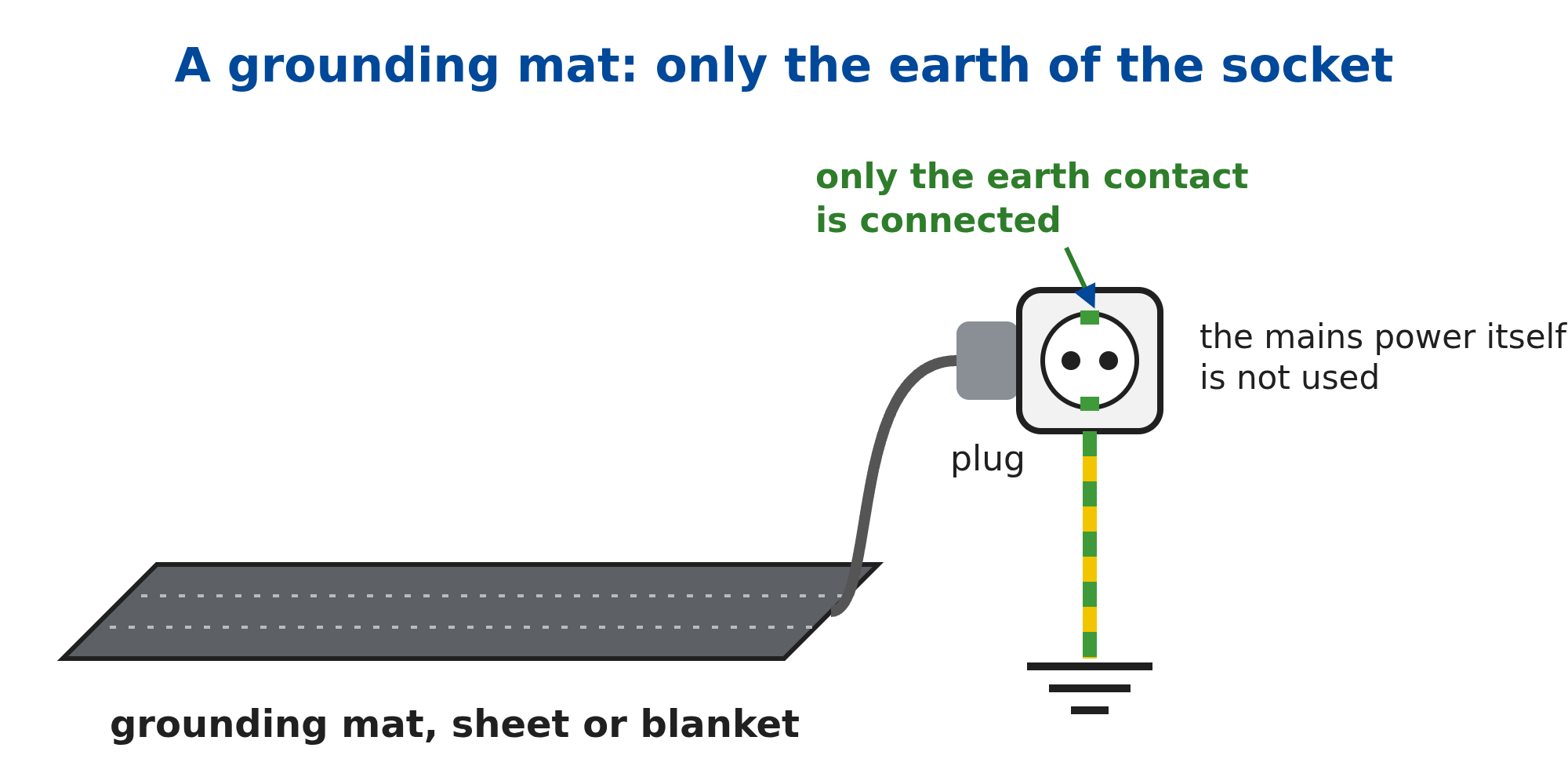
For your desk we have the grounding mouse mat: a mat of 25 by 30 centimetres in conductive PU leather, with a cord of about 4.5 metres and an earthing plug. You simply use it as a mouse mat, so your hand rests on it while you work.

Grounding mouse mat
A mat in conductive PU leather for your desk, with a cord of about 4.5 metres and an earthing plug for a socket with an earth contact.
View the grounding mouse matIs a grounding mat safe?
A grounding mat uses no power, but its cord does connect it to your electrical installation. That is why a few rules apply.
- Only in a socket with an earth contact. Without an earth wire in the socket there is no connection to the earth, and a grounding mat does nothing. Our plug fits type E and F sockets, as used in the Netherlands, Belgium, Germany and France. Elsewhere, for example in the United Kingdom, use a travel adapter that carries the earth through. An adapter, travel plug or extension lead must carry the earth through as well.
- If in doubt, check your socket. You can do this with a socket tester, or ask an electrician.
- Use the cord that comes with it. A good grounding cord contains a safety resistor, just like the wrist strap in electronics. It limits the current if a fault ever occurs in the installation. In the cord of our grounding mat, it is 100 kΩ.
- Unplug it during a thunderstorm, and also before you clean a grounding product.
- Clean it as the manual describes. Wipe a PU leather mat with a slightly damp cloth and clean water, without alcohol or cleaning products: they damage the conductive layer.
And grounding with crystals?
With crystals, grounding means something else: standing with both feet on the ground, calm and in the here and now. Stones such as hematite and tourmaline are called grounding stones for that reason. This has nothing to do with electricity and needs no cord. It is a tradition of its own, with a language of its own.
What grounding is not
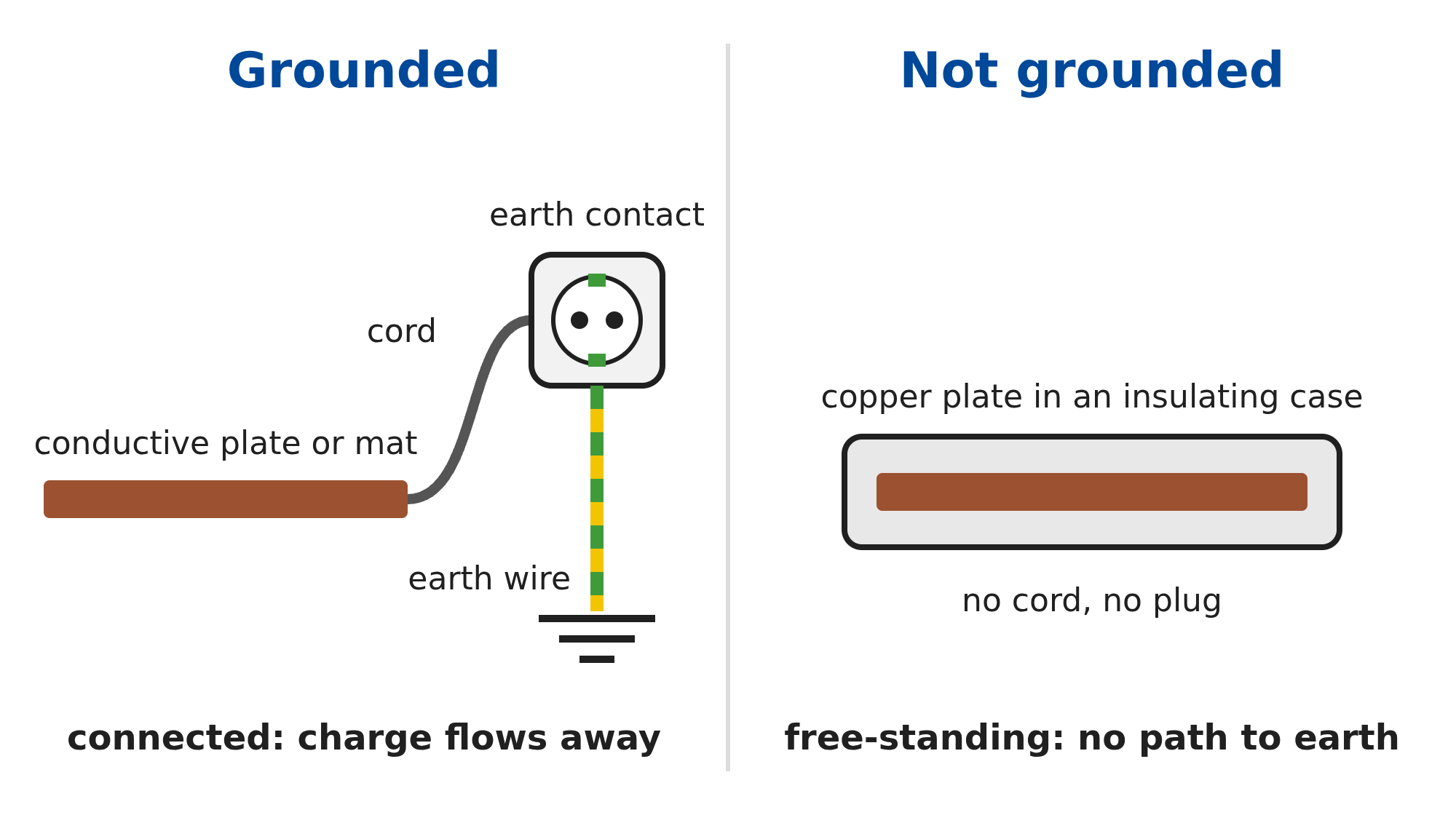
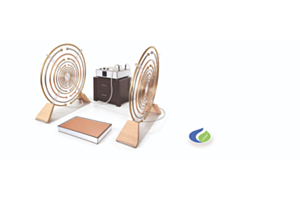
A copper plate without a cord is not grounded. It conducts just as well, but there is no path to the earth, so whatever builds up on it stays on the metal. The CopperWave, the copper plate we make for the setup with the Multiwave Oscillator, is deliberately not grounded: no cord, no plug, and the copper sits in a case of insulating rigid PVC. You can read why in our blog about the CopperWave.
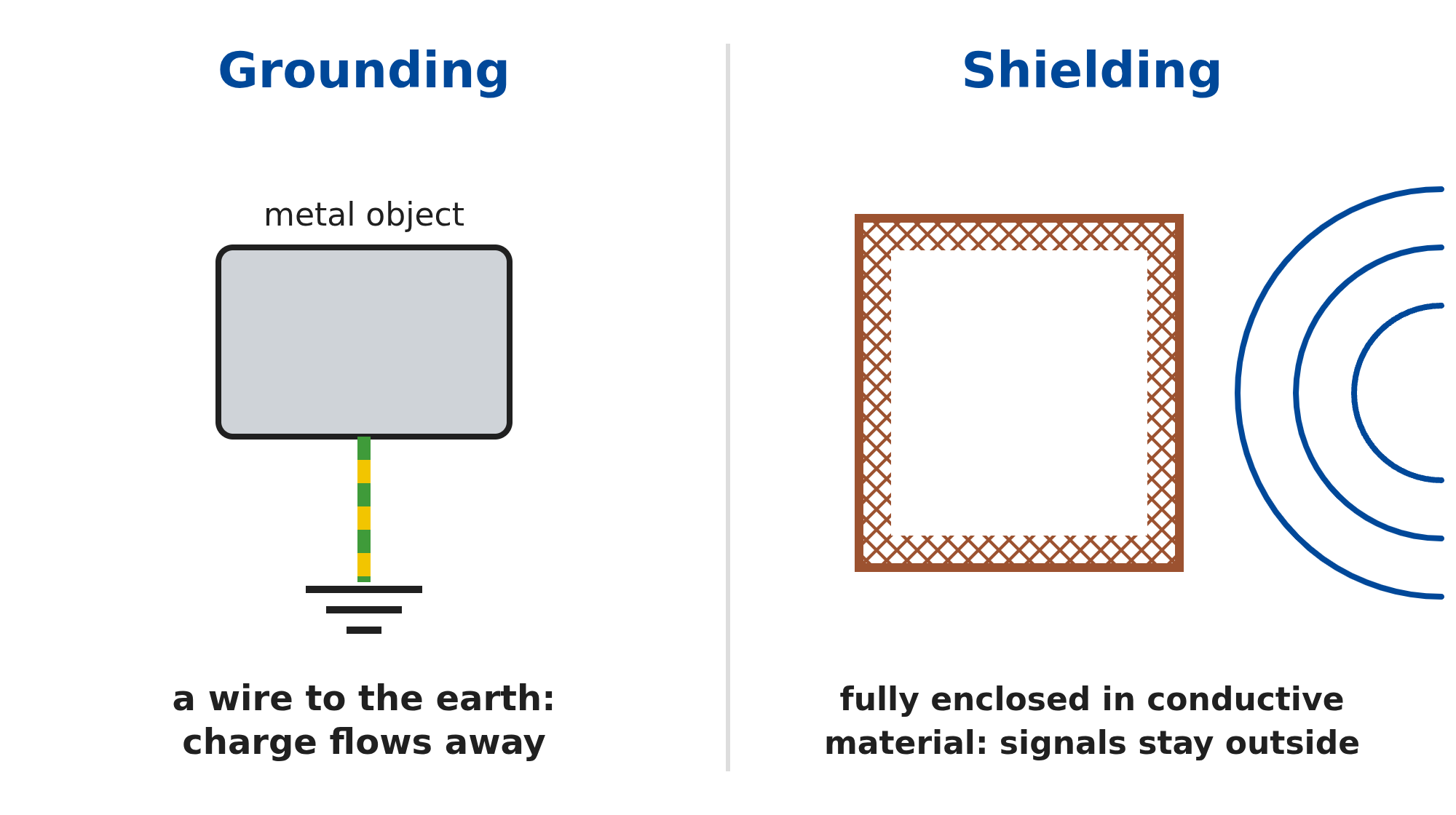
Shielding is something else too. A Faraday cage keeps signals out because it is completely enclosed in conductive material. What matters there is the enclosure, not a connection to the earth. You can read how that works in What is a Faraday cage?
Something new every week
We write every week about water, energetic products and frequencies, and about what we come across in practice. No sales talk — just what we have looked into and measured ourselves.
In short
Grounding means connecting yourself to the earth, so that the voltage between you and the earth disappears. Indoors, the wiring in your home often puts a small alternating voltage on your body, and on dry days you build up static charge. Grounded, that voltage drops to almost zero and the charge flows away. Always use a socket with an earth contact and a cord with a safety resistor.
Sources
- BS 7671, Requirements for Electrical Installations (IET Wiring Regulations, 18th Edition).
- ANSI/ESD S1.1, Wrist Straps, EOS/ESD Association.
Last updated: October 2026





 Made with