
What is a Faraday cage? And why your car key could use one too
If you have ever sat in a car during a heavy thunderstorm, you will probably have heard it: stay put, you are safe in the car. That is true, but usually for a different reason than people think. It is not the rubber tyres that protect you. It is the metal body around you. It acts as a Faraday cage, and the same principle is at work in things you use every day, from your microwave to the little box you keep your car key in.
How does a Faraday cage work?
In 1836 the scientist Michael Faraday built a room and lined it entirely with metal foil. He exposed the outside to strong electrical charges and stepped inside himself with a measuring instrument. Inside, he measured nothing.
That is the heart of it. A shell of conductive material, such as metal or a fabric containing metal, catches electrical charge and electromagnetic waves on the outside and leads them around the space within. Whatever is inside notices very little. It also works the other way round: a signal sent out from inside the Faraday cage does not get out.
A cage like this does not have to be a closed box. A fine metal mesh works too, as long as the holes are small enough. You probably have one at home: in the door of your microwave. You can see straight through it, but the microwaves stay inside.
A Faraday cage can also be big enough to stand in yourself. We make one as a tent: the Faraday cage of 200 by 200 by 230 centimetres, with its own frame.
What does a Faraday cage protect you from?
A Faraday cage blocks wireless signals: radio waves, mobile networks, wifi, Bluetooth, GPS and the signals that cards and keys use to communicate contactlessly. Whatever is inside can neither send nor receive.
That is also where its limits lie. A Faraday cage does nothing about what happens outside it, and how well it works depends on the material and on how well it closes. A gap or an open flap is enough to let a signal through. That is why, for each use below, we explain how to check for yourself that it works.
Keyless entry and the relay attack
These days many cars open without you taking the key out of your pocket: the car senses that the key is nearby and unlocks. This is called keyless entry.
Thieves have found a clever way to use this. With a device at your front door, they pick up the signal from the key lying inside the house and pass it on to the car. The car thinks you are standing next to it and opens. This is known as a relay attack: nothing gets broken, and you hear nothing.
If your key is inside a Faraday cage, there is no signal to pick up.
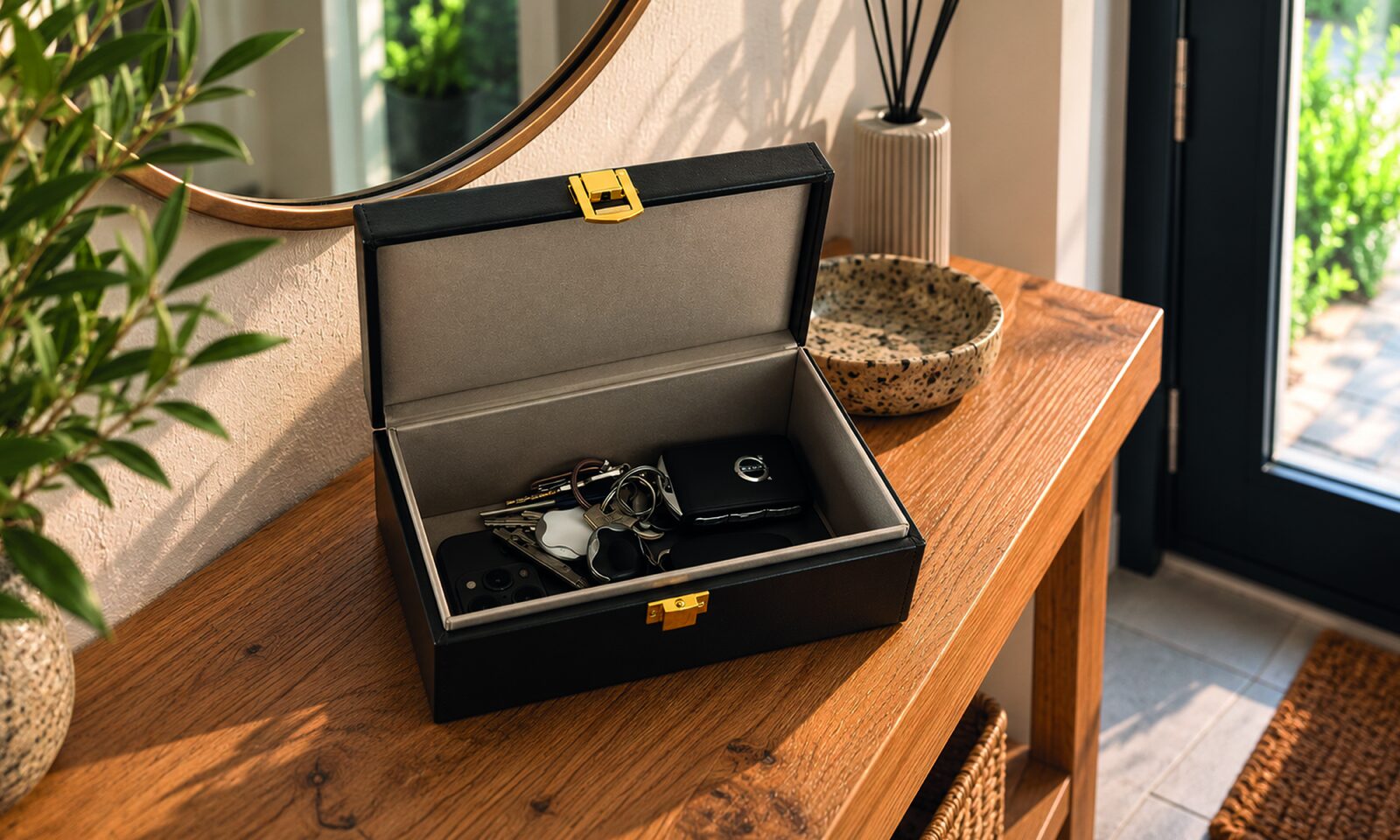
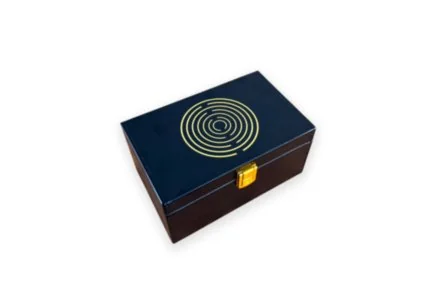
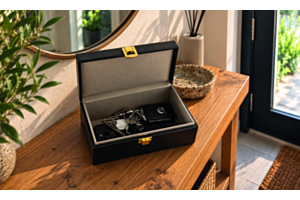
At home, a Faraday box for your car key is the most practical option: a small box by the front door where you put the key when you come in. Remember the spare key as well. It often sits in a drawer in the hallway and gives off a signal just the same. There is room in the box for both.
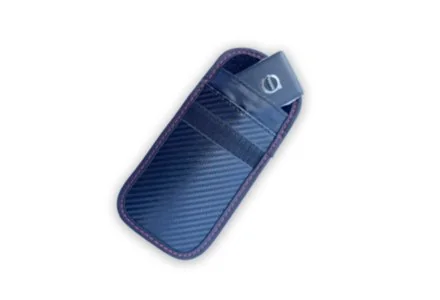
When you are out, in your coat pocket or bag, use a Faraday case for your car key. At the office, in a restaurant or at a party, your coat often hangs right by the door, and so not far from the car park.
Checking that it works is simple. Put your key in the box or case, close it properly, walk to your car and pull the door handle. If the car stays locked, all is well. Do this again from time to time, especially with a case that has been in use for a while.
 |  |  |
Your phone, properly put away
A phone in a drawer is still a phone that buzzes. In a Faraday bag it is properly out of the way. No messages, notifications or calls come in, and it does not share your location either.
Some people do this deliberately during meals or in the evening after a certain time, others during a meeting where they really want to be present. Flight mode does much the same in principle. But a phone tucked away out of sight in a bag is less tempting than one lying face down on the table. If you already have a Faraday box for your car key at home, most phones will fit in it too: a fixed spot in the hallway where key and phone both go off the air for the evening.
Two things worth knowing. While your phone is in the bag, you cannot be reached in an emergency, and you cannot call 999 or 112 yourself either. And a phone that cannot find a signal keeps searching, which uses battery. If you are putting it away for a longer time, switch it to flight mode first.
Here too, you can test it yourself: put your phone in the bag, close it properly and call yourself from another phone. If it does not ring, it works.
Something new every week
We write every week about water, energetic products and frequencies, and about what we come across in practice. No sales talk — just what we have looked into and measured ourselves.
Who is it worth it for?
If your car has keyless entry, a Faraday box or case for your key takes very little effort. Especially if the key is kept not far from the front door at home, which in most homes it is.
We will soon be writing a separate piece about RFID and NFC, the technology behind contactless keys and cards.


 Made with