
Countries with the Cleanest Drinking Water in the World
Fancy a glass of genuinely clean water? Then you are in luck: the United Kingdom was one of the ten countries with the cleanest drinking water in the world. Below: the full top ten, how drinking water quality is actually judged, which countries have the most polluted water, where drinking water comes from, and how the treatment differs by source.
How is the cleanest drinking water determined?
Judging drinking water quality means measuring it against a fixed standard. Across the European Union, the same standards apply in every member state, laid down in the EU Drinking Water Directive. Rankings of the cleanest drinking water then look at how safe the drinking water in a country is for the people who drink it.
The United Kingdom now runs its own regime rather than the EU one, but the standards remain closely comparable. In England and Wales the Drinking Water Inspectorate checks that water companies meet the requirements of the Water Supply (Water Quality) Regulations, with equivalent bodies in Scotland and Northern Ireland. Suppliers are legally obliged to test what comes out of the tap and to publish the results.
Top 10 countries with the cleanest drinking water
In an earlier edition of Yale University's Environmental Performance Index, ten countries shared the top score for drinking water. They are all in Europe, which is why they are listed here in alphabetical order. Access to clean and pure water sources, the financial means to invest, and the technology to treat the water are what allow these countries to stay comfortably inside the minimum quality standards.
Here they are:
- Austria
- Finland
- Greece
- Iceland
- Ireland
- Malta
- The Netherlands
- Norway
- Switzerland
- United Kingdom
Countries with the most polluted water
Clean water is not a given. Worldwide, more than 2 billion people lack safe drinking water, and around 106 million still drink straight from rivers, lakes or ditches (WHO and UNICEF, 2025). African countries such as Ghana, Ethiopia, Nigeria and Uganda have the most polluted water. In these countries there are few natural sources of clean water, limited funds to invest in water treatment technology, and no infrastructure to bring clean drinking water to people.
Where drinking water comes from
Drinking water is made from groundwater and surface water. In the United Kingdom the balance leans the other way from much of the continent: roughly two thirds comes from surface water — reservoirs, rivers and lakes — and about a third from groundwater held in aquifers, with chalk and sandstone aquifers supplying much of the south and east of England.
The section below sets out how the treatment differs between the three types of source: surface water, infiltrated dune water and groundwater.
Something new every week
We write every week about water, energetic products and frequencies, and about what we come across in practice. No sales talk — just what we have looked into and measured ourselves.
How treatment differs by source
Each type of source needs its own sequence of treatment steps before it produces reliable drinking water. Here is what happens to each.
Surface water
Surface water is pumped through pipes to a treatment works. There it passes through micro-sieves that take out the coarse dirt particles. Adding a flocculant makes sludge particles and other contaminants clump together so they too leave the water. The water is then made bacteriologically safe, and substances affecting smell, colour and taste are removed. It is stored in clean water reservoirs and pumped through the mains network so that it reaches your tap safely.
Infiltrated dune water
This method is used along the North Sea coast, and it is worth understanding because it is unusually effective. The water is pre-treated, then passed through micro-sieves and dosed with a flocculant in the same way as surface water. Clean, it goes into the dunes. After a month it is pumped back out of the ground. By then it is oxygen-free, so it is aerated, which strips out methane gas, iron, ammonium and manganese. It is aerated a second time and substances affecting smell, colour and taste are removed.
The water is then made bacteriologically safe, stored in large drinking water reservoirs, and pumped out through the mains network of the dune region.
Groundwater
Groundwater is pumped up and aerated to remove methane gas. It is then softened, which makes the granules settle out. A final filtration step takes the last small particles out of the water. The clean drinking water is stored in large reservoirs and pumped through the underground mains network so that clean drinking water is available all year round.
Cleaner water from your own tap
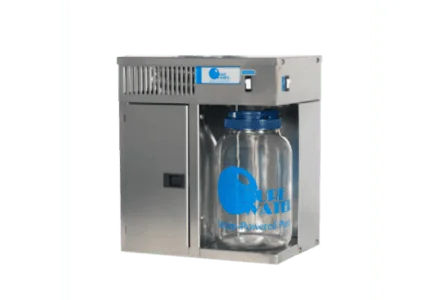
So the United Kingdom was among the ten countries with the cleanest drinking water in the world. That is a good starting point — but it can always be better. Tap water that meets the legal standard is not the same as water with nothing in it: hardness, chlorine used for disinfection, and traces of lead from older plumbing all remain within limits rather than absent. The simplest way to purify water at home is to filter it, for example with a water filter jug. If you want water without dissolved substances, you can use one of our water distillers.
Would you like to know what is in your tap water? You can measure it yourself. Our blog on TDS measurement explains how that works and what the result does and does not tell you.
Would you like more information about our products, tailored advice, or do you have a specific question? Contact us by email (info@meditecheurope.nl) or by phone (+31 527 292331). We are happy to help with products and equipment for clean water at home.



 Made with