
The Flower of Life: meaning and origin
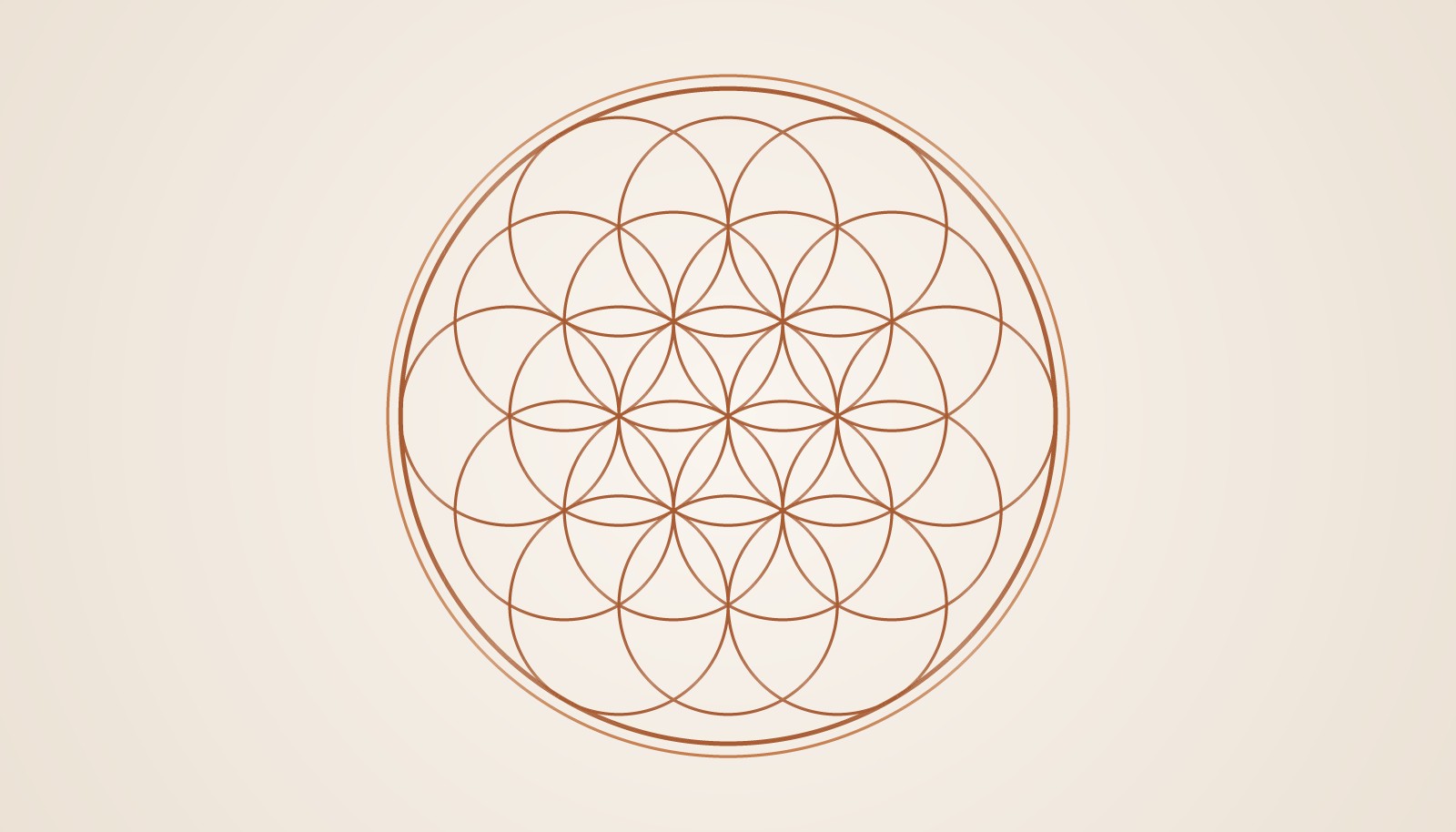
You may have seen it without knowing its name: a pattern of circles that overlap precisely, so that small flowers appear everywhere. On a piece of jewellery, a tile, a mural. This is the Flower of Life. A simple shape, and yet people have kept looking at it for centuries.
How the Flower of Life is built
You can draw it yourself with a pair of compasses. Draw one circle. Place the point on its edge and draw a second circle of the same size. Work your way round, each time from an intersection, and a six-petalled flower appears around the centre. Keep going and the pattern grows evenly outwards.
In the form we usually see today, nineteen circles sit within one large circle. A few smaller shapes have a name of their own:
- the Seed of Life: seven circles, the heart of the pattern;
- the Fruit of Life: thirteen circles that only touch;
- Metatron's Cube: formed when you connect the centres of the Fruit of Life with straight lines.
Most of these names are recent. The pattern itself is much older.
Where does the pattern come from?
Overlapping circles appear in many cultures. The best-known example of the Flower of Life is in Egypt, in the Osireion at Abydos, an underground sanctuary behind the temple of the pharaoh Seti I. The circles were drawn in red ochre on one of the granite pillars. Nobody knows exactly how old the drawing is; ochre cannot be dated. It is often said to be thousands of years old, but there is no evidence for that. Greek text right next to it suggests it dates from the Greco-Roman period, centuries after the temple was built.
Leonardo da Vinci was fascinated by it too. In his notebooks, the Codex Atlanticus, he drew the pattern of overlapping circles and wrote about its proportions. For him it was above all geometry: what can you create with nothing more than compasses and a ruler?
The name "Flower of Life" only became widely known at the end of the twentieth century, partly through the books of the American author Drunvalo Melchizedek. Since then the pattern has been everywhere.
What does the Flower of Life mean?
It has no fixed meaning. What people see in it differs from one tradition, and one person, to the next.
For many, the Flower of Life stands for connection: every circle touches the next, nothing stands alone. Others see the beginning of everything in it, a shape that grows from a single point and keeps expanding. In what is called sacred geometry, the pattern is seen as a basic form from which other figures arise. And for those who simply enjoy looking at it, it is above all beautiful: calm, balanced, endless.
What it means to you is yours to decide. Perhaps that is exactly what makes the pattern so lasting.
Something new every week
We write every week about water, energetic products and frequencies, and about what we come across in practice. No sales talk — just what we have looked into and measured ourselves.
The Flower of Life in everyday life
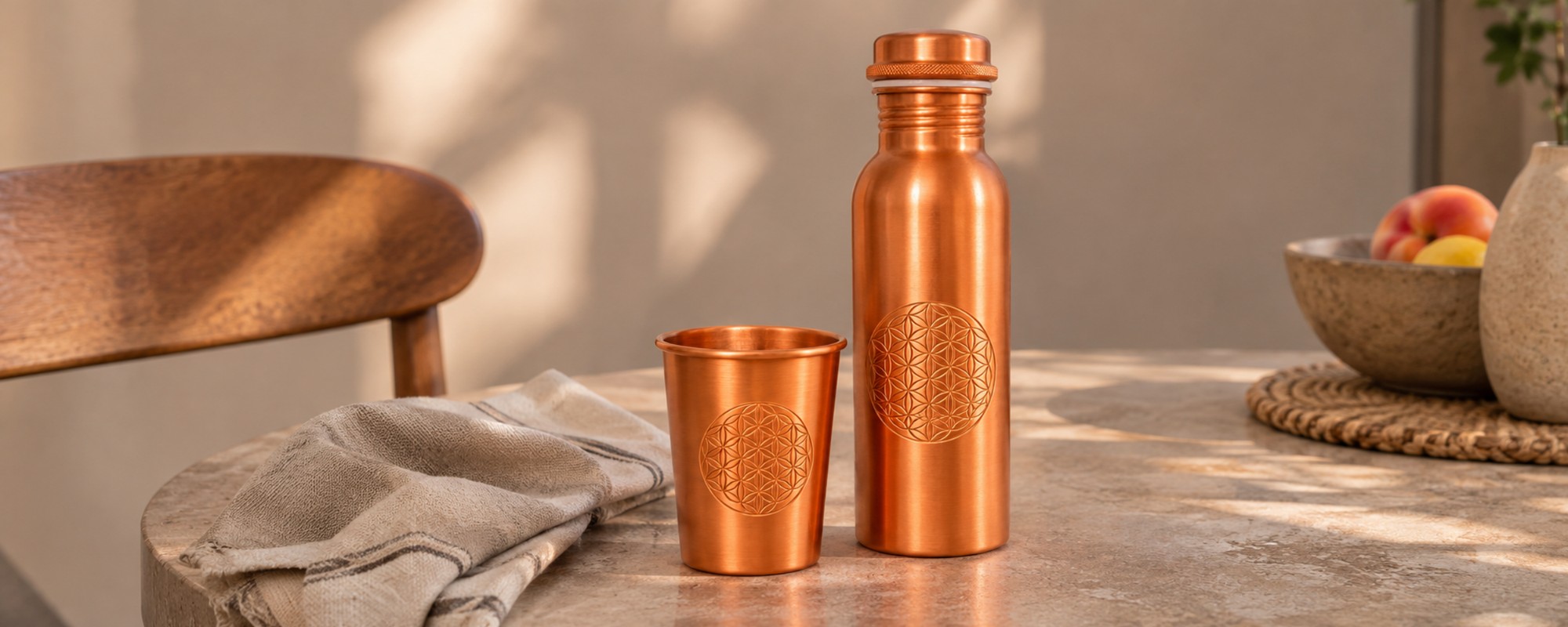
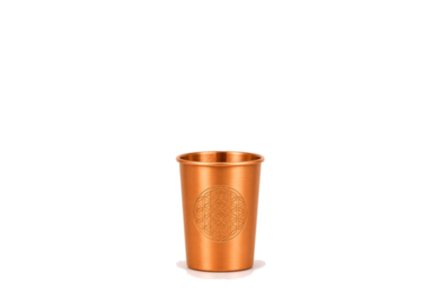
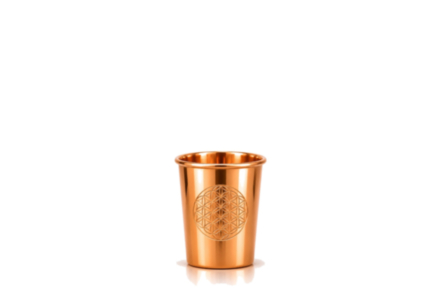
Today you will find the Flower of Life on jewellery, tiles and textiles, and on everyday objects. Ours too: it is engraved on our copper water bottle with the Flower of Life and the matching copper cup, in matte and shiny. An ancient sign on something you hold every day.
Frequently asked questions
What is the difference between the Flower of Life and the Seed of Life?
The Seed of Life is the heart of the Flower of Life: seven circles. The Flower of Life is the larger pattern, usually nineteen circles within one large circle.
How old is the Flower of Life?
Overlapping circles have been used for a very long time. The well-known drawing at Abydos probably dates from the Greco-Roman period. Leonardo da Vinci drew the pattern around 1500.
What does the Flower of Life stand for?
That differs per person and tradition. Often mentioned: connection, unity and the beginning of everything.
Can I draw the Flower of Life myself?
Yes, with a pair of compasses. Start with one circle and each time place a new circle of the same size on an intersection.
Sources
- Leonardo da Vinci, Codex Atlanticus, fol. 307 v, c. 1478–1519. Veneranda Biblioteca Ambrosiana, Milan.
- Drunvalo Melchizedek, The Ancient Secret of the Flower of Life, volume 1. Light Technology Publishing, 1999.
Last updated: November 2026




 Made with